
What is OTEC?
OTEC is a technology that makes use of solar energy to create electricity. Instead of using photovoltaic cells as solar collectors, the ocean surface is used.
How does OTEC work?
To many, the concept of making electricity from the temperature of the ocean is a novel concept. Yet it’s principles are simple.
Ocean Water Temperature Difference
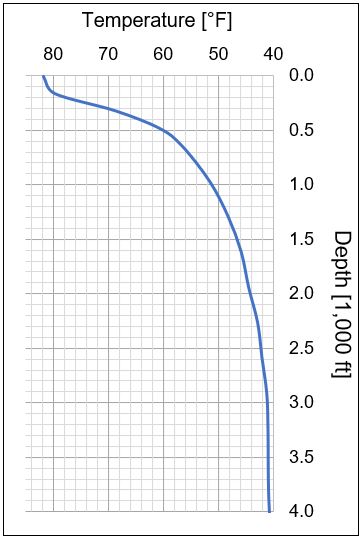
Typical Ocean Temperature Profile
Most of the electricity generation today is accomplished with a temperature difference. On the hot side is steam, heated by either coal, petroleum, natural gas, or nuclear reaction. On the cold side is river water, ocean, or air cooling with cooling towers. The hot steam turns a turbine-generator, making electricity, and the cold water condenses the steam to pump it back to the boiler.
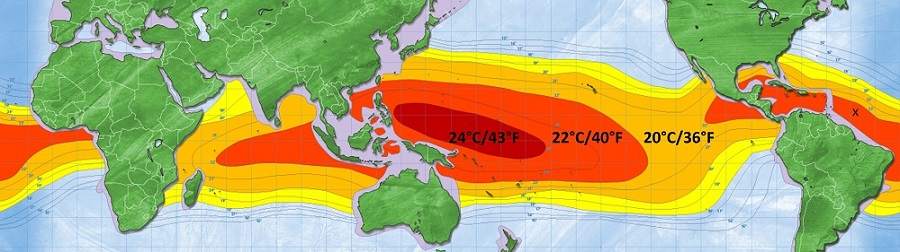
OTEC is similarly driven by the temperature difference between the top and the bottom of the ocean. While this temperature difference is much lower than in traditional power plants, the ocean has a practically unlimited supply of water with this temperature difference. At 4,000 ft (1,200 m), the temperature is relatively constant at about 42oF (5.6oC) throughout much of the ocean.
The Power Cycle
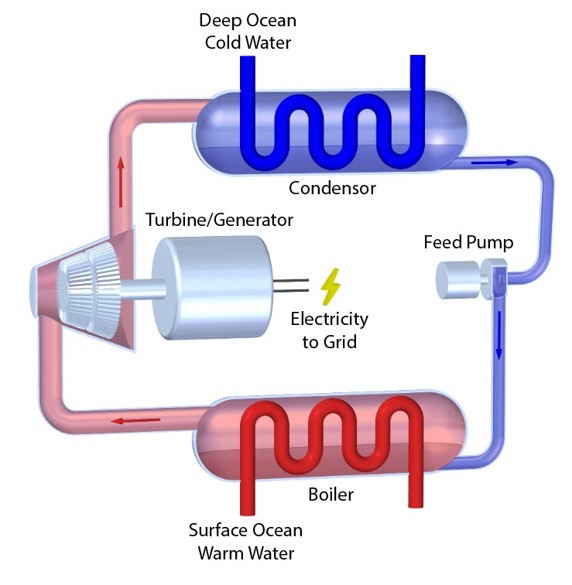
To generate electricity from the 40oF temperature difference found in much of the ocean, a working fluid is used in a closed cycle. This working fluid is chosen so that the warm ocean water will boil it into a superheated vapor and the cold ocean water will condense it back into a liquid. The superheated vapor spins a turbine which drives a generator. A portion of the electricity is used to run the pumps and accessories in the plant while the excess power is sent to the grid.
Is OTEC proven?
The principles of OTEC first suggested in the 1880’s were proven later in the early 1930’s. However, the practicality of building a competitive commercial operating plant that supplies baseload power into an established power grid has been the primary roadblock to seeing OTEC in large-scale deployment.
This is the challenge on which Sea Solar Power has focused for over 50 years. SSP has taken a unique approach to this challenge that has brought the company to the forefront of OTEC development in offering the only viable full-size floating plant design for a sizable baseload net power output that is economically competitive with diesel generated electricity today.
How does OTEC compare to other renewable energy methods?
70% of the world’s population lives in the tropical regions of the world which are ideal for OTEC power generation, and all of the world can be impacted through the power grids. Unlike Wind and Solar PV, OTEC is not weather dependent, producing consistent power day and night, on windy and still days. With Sea Solar Power’s plant design being largely deep underwater, it is able to withstand severe storms without disrupting power generation. The chart below compares OTEC to several other power generation methods.
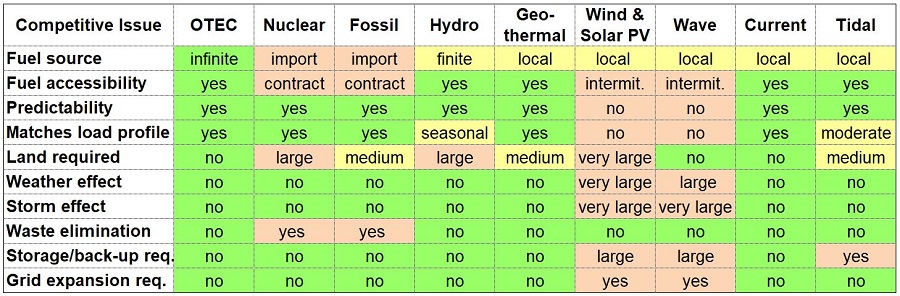
While Wind and Solar PV are often considered for renewable energy, they are facing increasing headwinds as government subsidies are decreasing and now need to demonstrate viability. Island nations recognize that a solar field can tie up valuable real estate that could be used for tourism and food production. Some islands have decided against wind turbines after learning their weather forecasting may be impacted by doppler radar interference. Both solar fields and wind turbines are also highly vulnerable to hurricane winds, as Hurricane Maria demonstrated in Puerto Rico. It is for these reasons that an oil-rig style OTEC plant becomes a front-runner, producing base-load power with minimal land resources under all weather conditions.
Why hasn’t OTEC taken off?
Small OTEC plants have been built to demonstrate the technology, but a commercially viable plant has yet to be made. Several factors have influenced this.
Scalability
For OTEC to be commercially competitive the plant must be a floating plant of sufficient size. It must be a floating plant because bringing an electrical cable to shore is much less expensive than bringing a cold-water pipe to shore. The plant must be of sufficient size (we estimate a minimum of 10 MW – ideally 20 MW) to make the cost and installation of the cold-water pipe viable. For example, a 9-foot pipe can power a 10 MW SSP plant, but a 13-foot pipe would power a 20 MW SSP plant without adding significant cost. This minimum-size requirement for commercially viable OTEC impacts the up-front costs.
Up-Front Costs
Similar to other renewable energy methods such as solar PV, hydro, or wind, OTEC’s electricity cost is primarily dependent on the initial cost of the equipment and its expected life. Thus the expense for decades of electricity is paid up front.
Many tropical island nations adding power capacity consider wind, solar, or additional fossil fuel generation, which can be added in small increments. OTEC, on the other hand, is similar in scope to building a geothermal plant or hydro dam. It would not be cost effective to build capacity incrementally, and thus, a larger expense is required.
Who will build first?
While many business ventures strive to be first to market, utilities generally do not. They are more inclined to choose power-generation methods that others are already using, even if it results in more expensive electricity. We fully expect OTEC to be a large energy resource utilized in the future, but it must start with the first one.
 Sea Solar Power